
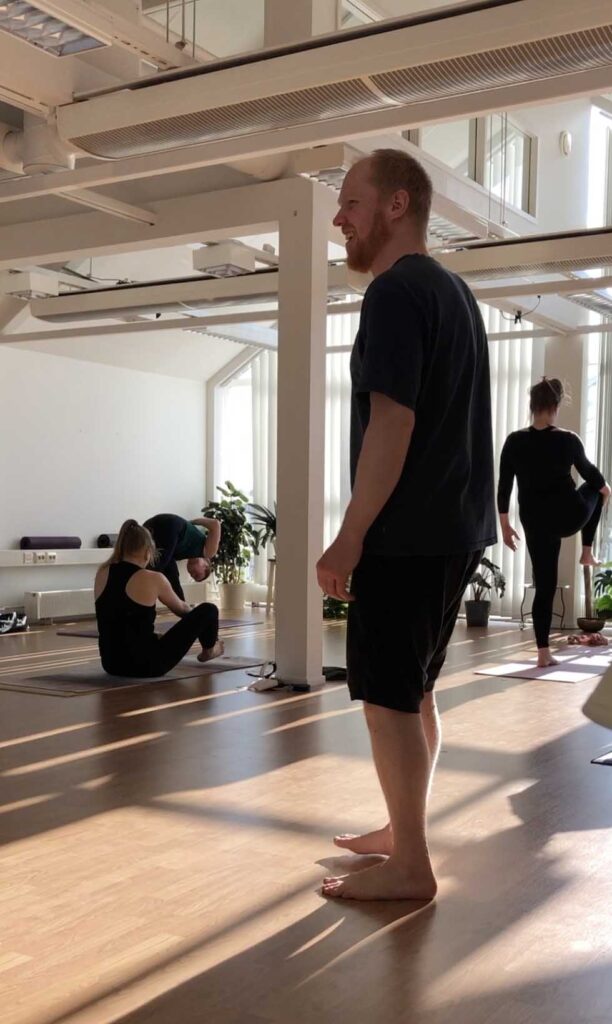
Traditional Morning Practice
The practice is best done in the morning on an empty stomach, and is traditionally done 6 days a week. When doing this practice first thing in the morning, the mind have still not been activated and stimulated by reading news, the digestive system is easy to clean, and the air is rich in prana (life force) in the early morning hours when the city still sleeps.
Eight limbs of yoga
The term Ashtanga Yoga means “eight limbs of yoga” and refers to the eightfold path described in Patañjali’s Yoga Sūtras, composed approximately 1,600–1,800 years ago. The modern Ashtanga Vinyasa Yoga system developed much later, in the 20th century.
In the second chapter of Patañjali Yoga Sutras, he describes the 8 limbs of yoga practice: yama (ethical restraints), niyama (personal observances), āsana (yoga postures), prāṇāyāma (breath control), pratyāhāra (withdrawal of the senses), dhāraṇā (concentration), dhyāna (sustained concentration / meditation), samādhi (meditative absorption).
History
The Ashtanga yoga sequences we know today adhere from Sri Tirumalai Krishmacharya (1888–1989) as he was teaching young boys in the 1930:ies. One of those boys was Sri K. Pattabhi Jois who came to study extensively with his guru for over 35 years, and then in 1948 opening the Ashtanga Yoga Nilayam in Mysore, India (later Ashtanga Yoga Institute, KPJAYI).
Sri Tirumalai Krishnamacharya studied 7 years in the Himalayas with his guru Sri Ramamohan Brahmacharya around the years 1916–1924 (not exact). According to traditional accounts, after completing his studies, his guru instructed him to marry, raise a family, and teach yoga to householders rather than become a renunciate.
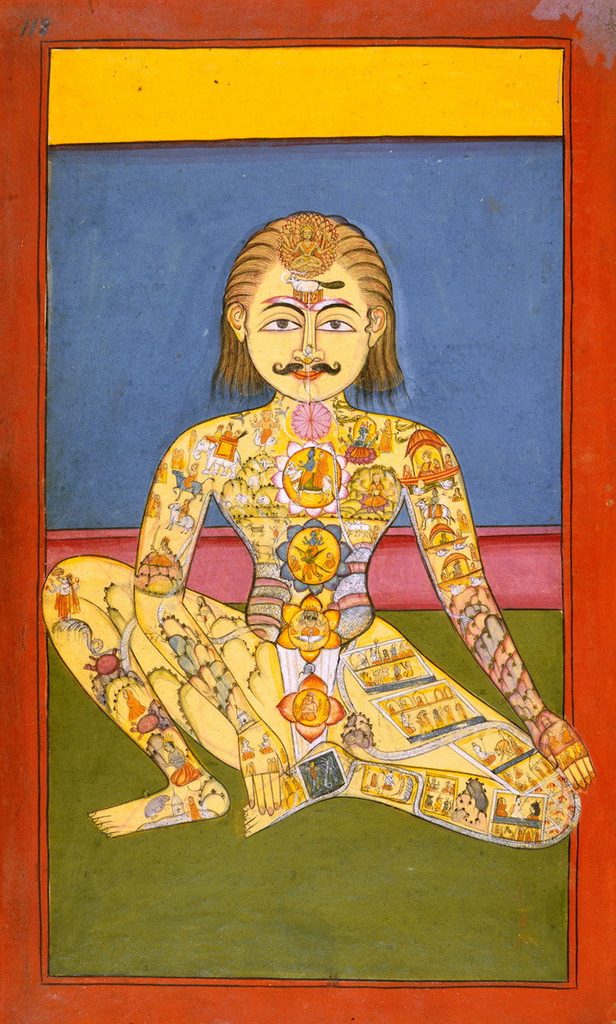
Picture source: Joga Pradipika 1737 by Ramanandi Jayatarama. Digital image in public domain / British Library
What is the practice today?
Our Ashtanga vinyasa yoga system we know today, is based on what Sri T. Krishnamacharya learned from his guru, and the legend of the text Yoga Korunta by Rishi Vamana. Krishnamacharya found this text in the library of the university of Calcutta (now Kolkata) sometime in the 1920-ies or 1930-ies. This book was famously eaten by insects, and has been lost, and has never been independently verified.
Pattabhi Jois has told in interviews that the book Yoga Korunta contained complete asana and vinyasa sequences found in Ashtanga Yoga. Wether Pattabhi Jois actually saw the book himself, or only learned it orally from Krischnamacharya is unknown. Whichever the case is, it was allegedly an important and historical source for the elaborate Ashtanga Yoga vinyasa system.
Ashtanga is both a practice and a philosophy united into one. The practice is as much designed for developing physical health, as for developing mental and spiritual health. You touch on all of the eight limbs every single time you practice, developing a more calm, concentrated and meditative mind, being less disturbed by the senses.
According to Patañjali, the problem we humans have, is that we mostly identify with our mind. With the breath and internal focus developed by the practice, you are slowly creating a bit of space between yourself and your mind, bringing forth the true seer (draṣṭā).
Although yoga developed within the spiritual and philosophical traditions of India, practicing yoga does not require you to belong to any particular religion. Yoga exists for the purpose of illuminating your innermost self, the seer, the soul, and being able to see the world uncolored by the conditioning of the mind (for example, uncolored by hate or envy or greed).
Experiencing this light within yourself, you will more easily see it in others as well and all around you, realizing we are all one big family, humans, nature, and all living beings. Harming nature, is to harm yourself, which in turn develops more kindness inside you.
What do we practice?
The physical practice is a meditative system of yoga āsanas (postures) that we link with the breath for deep concentration (vinyasa), bringing about more awareness of your whole being.
From the outside, you might mistaken for the asanas themselves to be the important part, or for making the number of asanas somehow important. This is however an illusion. A foundational asana, such as trikonasana, is equally, or arguably much more important than an advanced arm balancing asana.
The asana is just something we do to learn to breathe through to deepen our internal control and awareness. The quality of your breath is much more important than any advanced asana.
While the practice might look athletic at first, it is really a system for cleansing the body and the mind, making you sharp and true to yourself, weakening mental patterns (kléshas & samskaras) that are creating certain mental burdens.
When you find strength in the practice, you are not only strengthening the body, but you will get stronger mentally as well, bringing you up to good spirits.
How does an Ashtanga yoga class work?
Unlike many yoga styles where the teacher may introduce a different sequence every time, Ashtanga Yoga follows a structured sequence of postures. This allows you to easily become familiar with the practice, gradually memorize it, and practice independently with guidance and help from your teacher.
This system makes it a lot easier to deepen your focus and internalize your awareness, as there are you external instructions or music to constantly pay attention to. You pay attention to yourself.
In traditional Mysore-style classes, each student practices at their own pace, following a sequence adapted to their experience and abilities. The teacher provides individual instruction, adjustments and guidance as needed.
Traditional morning practice
The practice is best done in the morning on an empty stomach, and is traditionally done 6 days a week. When doing this practice first thing in the morning, the mind have still not been activated and stimulated by reading news, the digestive system is easy to clean, and the air is rich in prana (life force) in the early morning hours when the city still sleeps.
In our busy family- and city -lives, it is important to tailor the practice to your own needs and schedule. Maybe you can practice 2 or 3 times per week in the evening. Then do that. It’s not about all or nothing.
Why do we practice?
Apart from an inner cleanse, the physical practice will do good for your bodily health.
The practice does not require strength, but you will get stronger. The practice does not require flexibility, but you will get more flexible. The practice does not require any particular shape or fitness level, but you will get more energy from the oxygen you consume.
Staying motivated
To stay motivated on the path, it is important to learn at a pace that is right for you. Try learning too much at once, you only get confused, frustrated and lose motivation. Likewise, if you feel stuck at the beginning phases, the motivation will likely drop.
The Ashtanga practice does look quite attractive, and it easily happens that some people want to skip the “boring” part and jump to the more advanced practices, without mastering the breath first. Please trust your teacher and surrender to the pace of the practice. It is there for a reason.
Start learning from an experienced teacher who can teach you at your ideal pace. How you are taught may differ greatly if you are 28 or 62 when you are starting out, and also depending on how often you practice.
Yoga does change you
Yoga will change you, both literally and metapohrically.
Let’s say you were a person that did not practice trikonasana or headstand. Suddenly you are a person who practices trikonasana and headstand several times, or at least once, per week. It might sound like I’m joking, but that has a significant impact on your life in many ways.
The blood might start to circulate better, the digestive system gets some help getting cleansed, organs, lungs and fluids are regularly starting to be put upside down, helping to physically clean out the body.
On the metaphorical or philosophical side, I see one common symptom in people who have practiced yoga for while. They become more kind people. Often develops more understanding, and are able to widen their perspectives.
I personally believe that all humans deep down are kind people on the inside. A yoga practice takes you closer to that what you truly are.
Where do I start?
Start from a beginners course, or join any Mysore practice with an experienced teacher who can teach you appropriately. Even if you have previous yoga experience, it’s not a bad idea to start from a beginners course, as the beginners courses are quite rich in content.
The body can feel a bit more stiff in the morning – but the mind is less restless, and can take you deeper into the yoga mind.
This is a meditative practice of Tapas (austerity) in the form of Asana (posture), which will actually leave positive imprints (saṃskāra’s) in the mind and subconscious, and make space for new experiences, and new ways to look at the world.
Practicing early often makes the practice feel clearer, calmer and less rushed, as the restless mind have easier time to focus early in the morning.
You can choose at what time you want to start your practice.
New to Ashtanga Yoga? Please join at least 3 days.
Complete beginners will learn short sequence to start with, and maybe practice 30-45 minutes in the mornings. Your practice will then start growing gradually and organically.
Who this is for
- Complete beginners (join at least 3 days)
- Or you already attend Mysore classes
- Or you have practiced Ashtanga Yoga in led classes
Schedule of the week
Teacher: Alexander Lemberg
Start your morning practice between 6.00 – 6.30. Each class available for 15 credits, except the Saturday philosophy class at 10 credits.
Monday 14.12.2026
06.00 – 08.00 Ashtanga – Mysore
06.15 – 08.00 Ashtanga – Mysore
06.30 – 08.00 Ashtanga – Mysore
Tuesday 15.12.2026
06.00 – 08.00 Ashtanga – Mysore
06.15 – 08.00 Ashtanga – Mysore
06.30 – 08.00 Ashtanga – Mysore
Wednesday 16.12.2026
06.00 – 08.00 Ashtanga – Mysore
06.15 – 08.00 Ashtanga – Mysore
06.30 – 08.00 Ashtanga – Mysore
Thursdays 17.12.2026
06.00 – 08.00 Ashtanga – Mysore
06.15 – 08.00 Ashtanga – Mysore
06.30 – 08.00 Ashtanga – Mysore
Friday 18.12.2026
06.00 – 08.00 Ashtanga – Mysore
06.15 – 08.00 Ashtanga – Mysore
06.30 – 08.00 Ashtanga – Mysore
Saturday 19.12.2026
08.00 – 10.00 Ashtanga – Mysore
08.15 – 10.00 Ashtanga – Mysore
08.30 – 10.00 Ashtanga – Mysore
10.15 – 11.30 Yoga Philosophy

Join the practice – How to book
You can use your any valid class pass to book your classes, or buy and book with the offers below. Just scroll down and book.
If you have a recurring membership (yearly or 6 months), this program is included for you – just book.
Full week offer
108€
(100 credits, normally 161€)
Purchased credits usable for 60 days for other classes in case you need to cancel.
6 days Mysore practice only (no Saturday philosophy)
99€
(90 credits)
Purchased credits usable for 60 days for other classes in case you need to cancel.
5 days Mysore practice
84€
(75 credits)
Purchased credits usable for 60 days for other classes in case you need to cancel.
4 days Mysore practice
69€
(60 credits)
Purchased credits usable for 60 days for other classes in case you need to cancel.
3 days Mysore practice
55€
(45 credits)
Purchased credits usable for 60 days for other classes in case you need to cancel.
2 days Mysore practice
40€
(30 credits)
Purchased credits usable for 60 days for other classes in case you need to cancel.
1 day Mysore practice
25€
(15 credits)
Purchased credits usable for 60 days for other classes in case you need to cancel.
Book your classes
After the purchase, book the classes here below, or in the regular booking calendar.